
> **3.0.0 stable release · 2026-10-26**. Java 21 / Spring Boot 4.1.1 / Spring AI 2.0.1 / AgentScope 2.0.4. AgentScope drives execution loops; MateClaw retains tool approvals, permissions, Goals, SSE and persistence. See Releases for stable builds. > [3.0.0 architecture changelog](CHANGELOG.md) > Includes all changes since 2.3.0: structured decisions, member file isolation, DSH SDK upgrades, voice preview and structured MCP presentation.

MateClaw Logo

# MateClaw

Your second brain

Pluggable Agent Runtime · Native + DSH · Spring Boot inside

[![GitHub Repo](https://img.shields.io/badge/GitHub-Repo-black.svg?logo=github)](https://github.com/mateaix/mateclaw) [![Documentation](https://img.shields.io/badge/Docs-Website-green.svg?logo=readthedocs&label=Docs)](https://claw.mate.vip/docs) [![Live Demo](https://img.shields.io/badge/Demo-Online-orange.svg?logo=vercel&label=Demo)](https://claw-demo.mate.vip) [![Website](https://img.shields.io/badge/Website-claw.mate.vip-blue.svg?logo=googlechrome&label=Site)](https://claw.mate.vip) [![Java Version](https://img.shields.io/badge/Java-21+-blue.svg?logo=openjdk&label=Java)](https://adoptium.net/) [![Spring Boot](https://img.shields.io/badge/Spring%20Boot-4.1.1-brightgreen.svg?logo=springboot)](https://spring.io/projects/spring-boot) [![Vue](https://img.shields.io/badge/Vue-3-4FC08D.svg?logo=vuedotjs)](https://vuejs.org/) [![Last Commit](https://img.shields.io/github/last-commit/mateaix/mateclaw)](https://github.com/mateaix/mateclaw) [![License](https://img.shields.io/badge/license-Apache--2.0-red.svg?logo=opensourceinitiative&label=License)](LICENSE) [[Website](https://claw.mate.vip)] [[Live Demo](https://claw-demo.mate.vip)] [[Documentation](https://claw.mate.vip/docs)] [[中文](README_zh.md)]
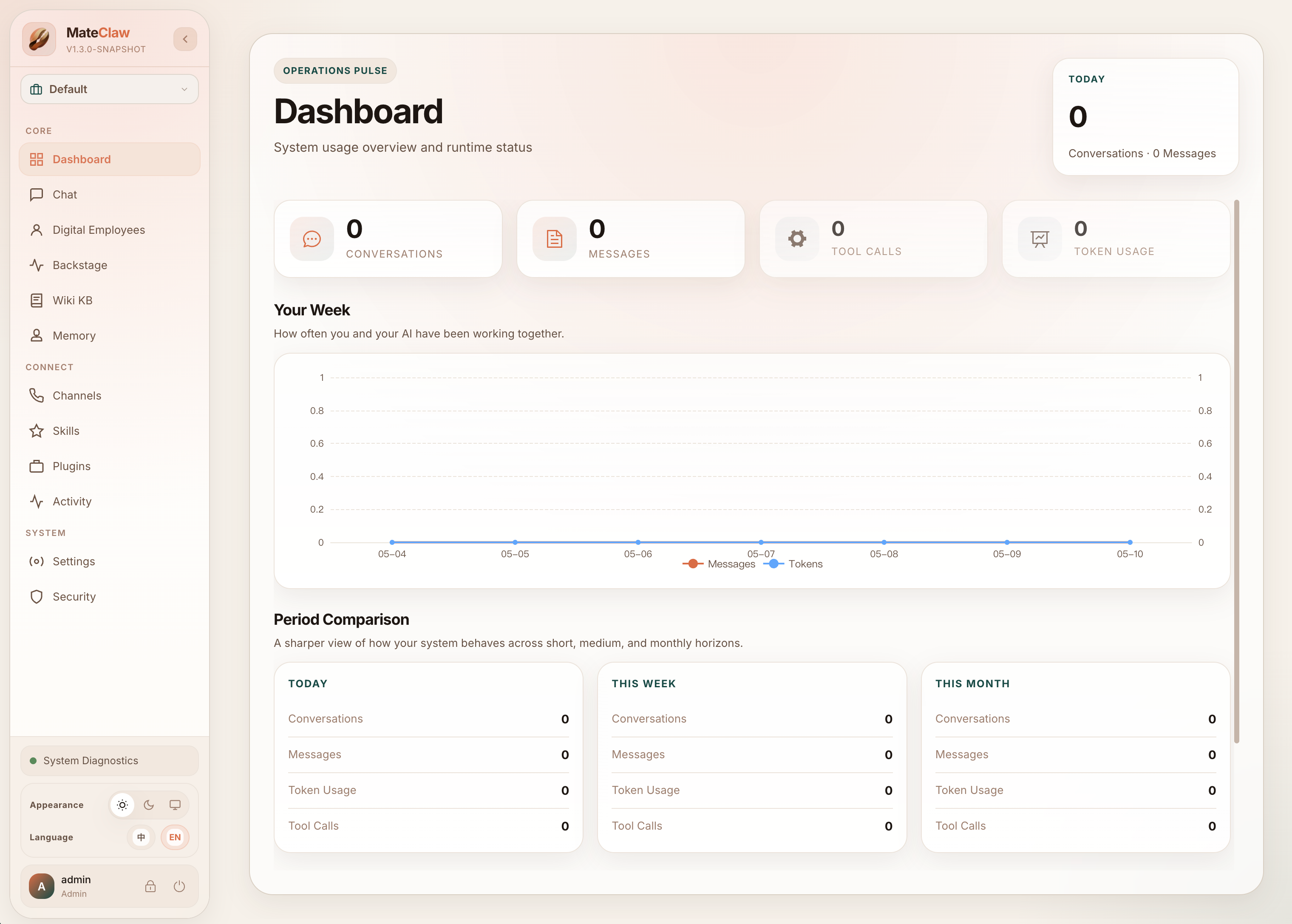
MateClaw Preview

--- > **3.0.0 — Governed execution, recoverable long tasks and team delivery.** Java 21, Spring Boot 4, Spring AI 2 and AgentScope 2 power the native runtime. Consistent context budgets, final-answer checks and team synthesis strengthen delivery while preserving approvals and workspace boundaries. [Release and upgrade notes](https://claw.mate.vip/docs/en/releases/3.0.0). Release date: **2026-10-26**. --- > **Other personal AI agents are built for one person. MateClaw is the one your IT department can actually sign off on.** > > Multi-user workspaces. Approval-gated sensitive actions. Full audit trail. Spring Boot Actuator health monitoring. Per-channel error isolation so one chat platform's outage doesn't take down the rest. One JAR in your environment; you control persisted data, and task content is sent only to model, channel, or tool services you explicitly configure. > > **And underneath, a real Agent Runtime.** An employee is no longer welded to one reasoning loop. Choose the native AgentScope runtime for ReAct, Plan-and-Execute, Goals, and Team Runs, or run DeepSeek Harness as a managed external loop over SDK JSON-RPC. Both paths converge on the same conversations, workspace boundaries, Tool Guard, event projection, and lifecycle controls. Most AI tools die when their vendor has a bad day. Most forget you the moment the tab closes. Most give you a chatbox and call it a product. **MateClaw is the whole widget.** One deployment. Reasoning, knowledge, memory, tools, channels — built together, not bolted on. And when your primary model is unavailable, the next healthy provider retries the current request. --- ## What changes in 3.0.0 3.0.0 includes the unpublished 2.4.0 development cycle. Release date: **2026-10-26**. Download published packages from Releases. - **Native execution:** AgentScope Java **2.0.4** runs ReAct and the tool loop within each Plan-Execute step. MateClaw retains plan scheduling, tool approvals, workspace permissions, cancellation, Goal acceptance and persistence. This path does not require a beta AgentScope Harness API. - **Consistent context budgets:** request preparation, compaction retries and summary calls account for messages, effective tool schemas and one output reserve. Partial request options inherit model defaults; an explicitly empty tool list disables inherited callbacks. Estimates are conservative, rather than provider billing counts. - **Governed decisions and recovery:** typed decisions default to SHADOW mode; existing domain constraints and Goal budgets still apply. Durable checkpoints block blind replay when side effects are uncertain. - **Long tasks and team delivery:** unfinished work can continue within runtime limits, requests needing user input wait for a reply, and Team Runs publish completion after final synthesis. Worker progress preserves full results and failure causes. - **Everyday improvements:** opt-in strict member file isolation, managed DSH SDK upgrades, voice selection/preview, structured MCP results and stricter model probes. Use Java 21 for source builds. Back up the database, workspace, plugins and configuration before migration; use that backup for rollback. [Architecture and upgrade notes](mateclaw-server/src/main/resources/docs/en/changelog.md) · [Model budget rules](mateclaw-server/src/main/resources/docs/en/models.md) ## Three things that make it different ### 1 · Your AI doesn't die when a model does Primary key expired. Vendor returns 401. Network blip. Quota drained. Other tools hand you a red error card. MateClaw tries the next healthy provider in configured order — including built-in and OpenAI-compatible options such as DashScope, OpenAI, Anthropic, Gemini, DeepSeek, Kimi, Ollama, LM Studio, and MLX — and attempts to recover the current request. It returns an error only when the available chain is exhausted. A provider health tracker parks bad vendors in a cooldown window so they don't waste seconds on every turn. You don't write a retry script. You drag providers into priority order in **Settings → Models** and watch the health dashboard fill with green dots as requests route around failures in real time. ### 2 · Knowledge that links itself Upload a PDF, a batch of markdown, a scraped page — raw material in. MateClaw's **LLM Wiki** digests it into structured pages, builds `[[links]]` between them, and preserves traceable citations for generated content. Open the citation drawer to inspect the corresponding source chunk and verify page or answer references. This is the difference between a warehouse and a library. ### 3 · One product, five surfaces | Surface | What it is | |---|---| | **Web Console** | Full admin — digital employees, models, skills, knowledge, security, cron, **runtime console** (see what every employee is doing, force-recycle in one click) | | **Desktop** | Electron app with a bundled JRE 21. Double-click, run. No Java install | | **Webchat Widget** | One `

