 0476447ab6
A bundle of stability fixes that all surfaced together while running the same long-form generation task across multiple turns. Each one addresses a distinct way the previous behavior silently dropped content the user had already seen on screen. 1. Mid-turn narrative persistence (StateGraphReActAgent + SummarizingNode). Intermediate ReasoningNode rounds and SummarizingNode broadcast their content_delta directly to the SSE channel for live display, but the StreamAccumulator only received the final answer. After refresh the assistant message showed only tool_call cards with no body text. StateGraphReActAgent now also forwards STREAMED_CONTENT (already set per round) as a persistOnly StreamDelta whenever it changes, so every narrative chunk lands in the accumulator's content buffer and gets written to mate_message. SummarizingNode now writes its summary into the same key so summarize narratives persist too. 2. Follow-up message queue, not dispose (ChatController#interruptStream). Sending a new message while a turn was running called requestInterrupt, which dispose()d the active Reactor chain mid LLM call. That cancelled the in-flight generation, lost partial tokens, and left the user staring at a half-finished bubble. The endpoint now uses enqueueMessage in all paths, matching the "wait for current turn, then run" behavior. The old requestInterrupt API is kept for any future force-replace UI but no caller routes to it. 3. Queued user message ordering (ChatStreamTracker.QueuedInput + ChatController.startQueuedMessage). interruptStream used to save the queued user message immediately, before the in-flight assistant message finalized in doOnError. listMessages orders by create_time ASC, so the queued user message ended up above the assistant reply it was supposed to follow. QueuedInput now carries contentParts; persistence is delayed to startQueuedMessage, which runs only after Asst-N is on disk. 4. JVM shutdown flush (ChatStreamTracker @PreDestroy + emergencySaveAccumulator). A mvn spring-boot:run restart used to wipe in-flight turns: SSE emitter timed out, ShutdownHook fired, HikariPool closed before doOnError could save. ChatStreamTracker now exposes an emergency-save callback per RunState; ChatController registers one per stream that snapshots the accumulator and writes status="interrupted_shutdown". @PreDestroy walks active runs, invokes the callback, then disposes. Spring's reverse-order bean teardown keeps ConversationService and Hikari alive long enough for the save to complete. 5. Observation thresholds for summarize (GraphObservationProperties + application.yml). The previous total-chars threshold of 12 KB triggered summarize after one or two RFC reads, costing a 40 to 80 second compaction LLM call per loop. Tuned to: total 200 KB, single 16 KB, large-result 32 KB, rounds safety net 25. Java field defaults reverted to the conservative original values so application.yml stays the source of truth. 6. Frontend thinking segmentation (useChat.ts thinking_delta + phase). Multi-round ReAct turns merged every reasoning + summarize round's thinking into one segment, accumulating to 9 KB+ in a single bubble. thinking_delta now uses findLast(running) so a tool_call_started or phase transition closes the previous segment and the next delta opens a fresh one. phase event also closes running thinking/content segments. 7. Other small things bundled: removed a debug metadata-keys log that flooded the log file with one line per stream chunk; fixed three stale tests that didn't compile after earlier constructor changes (WikiLogServiceTest, WikiOverviewSpliceTest, WikiProcessingServiceLazyTest); added rfc-066 documenting the unified message queue + priority refactor as the next logical step on top of these stabilizations. Verified end-to-end with multiple full sessions: a four-minute generation that produced the expected docx and a follow-up enqueue that ran cleanly after the previous turn naturally completed, without the old "Disposable unavailable" interrupt path. |
||
|---|---|---|
| assets | ||
| docker/searxng | ||
| mateclaw-plugin-api | ||
| mateclaw-plugin-sample | ||
| mateclaw-server | ||
| mateclaw-ui | ||
| mateclaw-webchat | ||
| .dockerignore | ||
| .env.example | ||
| .gitignore | ||
| docker-compose.yml | ||
| LICENSE | ||
| README_zh.md | ||
| README.md | ||










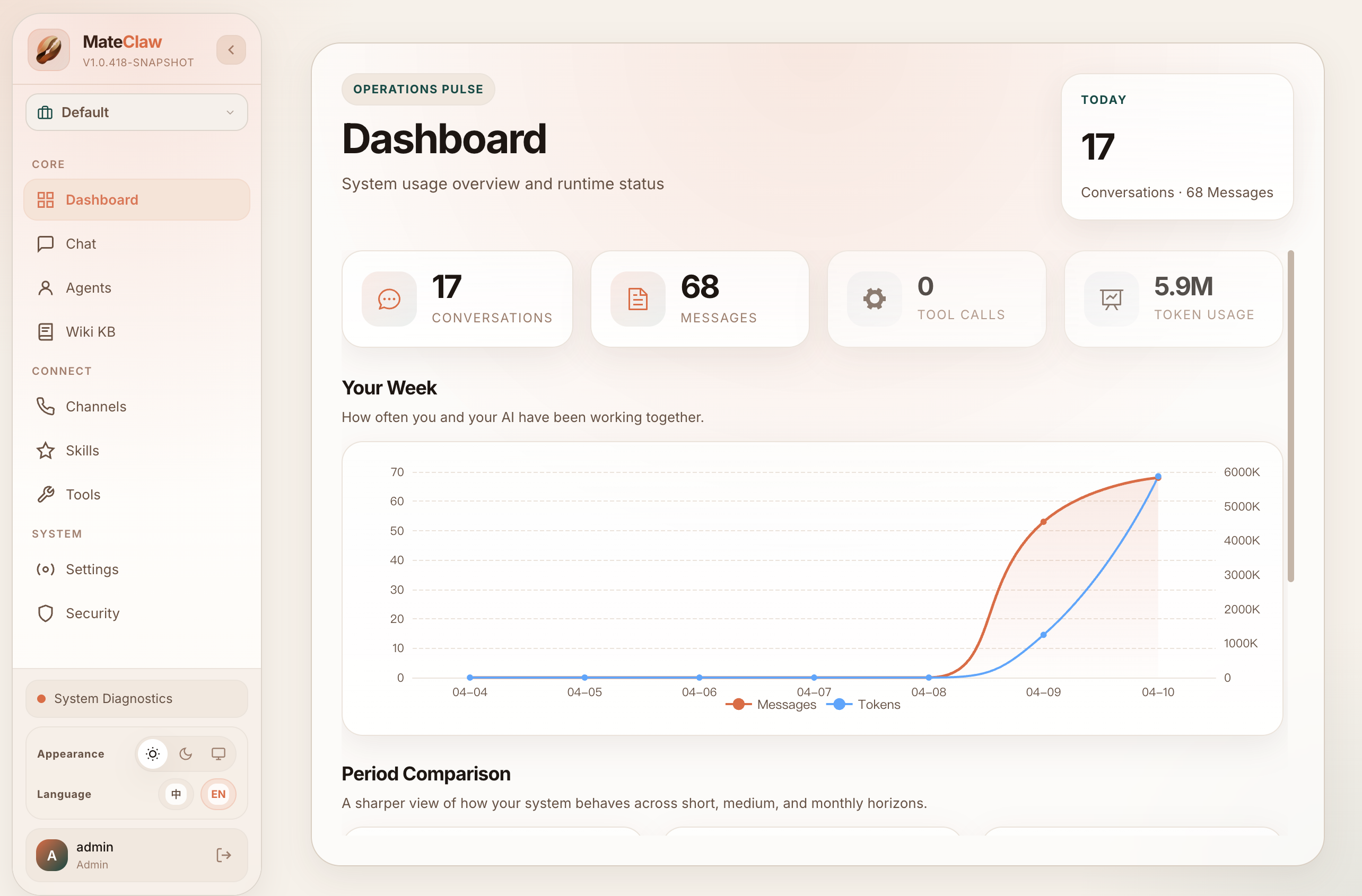
Most AI tools die when their vendor has a bad day. Most forget you the moment the tab closes. Most give you a chatbox and call it a product.
MateClaw is the whole widget. One deployment. Reasoning, knowledge, memory, tools, channels — built together, not bolted on. And when your primary model goes down, the next one picks up mid-sentence.
Three things that make it different
1 · Your AI doesn't die when a model does
Primary key expired. Vendor returns 401. Network blip. Quota drained.
Other tools hand you a red error card. MateClaw routes to the next healthy provider — DashScope, OpenAI, Anthropic, Gemini, DeepSeek, Kimi, Ollama, LM Studio, MLX, 14+ in total — and the user sees the reply finish. A provider health tracker parks bad vendors in a cooldown window so they don't waste seconds on every turn.
You don't write a retry script. You drag providers into priority order in Settings → Models and watch the health dashboard fill with green dots as requests route around failures in real time.
2 · Knowledge that links itself
Upload a PDF, a batch of markdown, a scraped page — raw material in.
MateClaw's LLM Wiki digests it into structured pages, builds [[links]] between them, and remembers where every sentence came from. Click a citation, see the exact source chunk. Ask a question, the page you get is stitched from the right chunks — with references you can verify.
This is the difference between a warehouse and a library.
3 · One product, five surfaces
| Surface | What it is |
|---|---|
| Web Console | Full admin — agents, models, tools, skills, knowledge, security, cron |
| Desktop | Electron app with a bundled JRE 21. Double-click, run. No Java install |
| Webchat Widget | One <script> tag embed. Drop it on any site |
| IM Channels | DingTalk · Feishu · WeChat Work · Telegram · Discord · QQ |
| Plugin SDK | Java module for third-party capability packs |
Same brain. Same memory. Same tools. Different doors.
$0 · No tokens metered. No seats billed. Your server. Your data. Your keys.
What's in the box
Agent runtime
ReAct for iterative reasoning. Plan-and-Execute for complex multi-step work. Dynamic context pruning, smart truncation, stale-stream cleanup — the boring stuff that makes long conversations actually work.
Knowledge & memory
- LLM Wiki — raw materials digest into linked pages with citations
- Workspace memory —
AGENTS.md,SOUL.md,PROFILE.md,MEMORY.md, daily notes - Memory lifecycle — post-conversation extraction, scheduled consolidation, dreaming workflows
Tools, skills, MCP
Built-in tools for web search, files, memory, date/time. MCP over stdio / SSE / Streamable HTTP. SKILL.md packages from the ClawHub marketplace. A Tool Guard layer with RBAC, approval flows, and path protection — capability needs boundaries.
Multimodal creation
Text-to-speech · Speech-to-text · Image · Music · Video. First-class, not add-ons.
Enterprise-ready
RBAC + JWT. Full audit trail. Flyway-managed schema that auto-heals on upgrade. One JAR to ship. MySQL in production, H2 for dev — nothing to change in your code.
AI is becoming infrastructure
On March 2, 2026, Claude went dark for 4 hours across API, web, and mobile. Three weeks later, another 5 hours. Every company that bet their AI strategy on a single vendor spent those outages staring at red error cards.
This is the same shift databases went through around 2010 and cloud went through around 2018: the winning layer stops being tied to one supplier. 57% of companies now run AI agents in production. None of them want one vendor's bad day to become their bad day.
MateClaw is that layer — built the Spring Boot way.
Why MateClaw
| MateClaw | OpenClaw | Hermes Agent | Claude Code | Cursor | |
|---|---|---|---|---|---|
| Multi-vendor failover | Chain + health tracker + cooldown | Swap providers via config | Orchestration w/ retry | Anthropic only | One model |
| Knowledge digestion | LLM Wiki + page-level citations | Canvas + memory | Skills Hub + memory | — | Code index |
| Multi-user admin | RBAC + approval flow + audit | Config-file first | Single-user CLI | Enterprise tier | Teams plan |
| Surfaces | Web admin + Desktop + Widget + SDK + 6 IM | 25+ chat channels | 15+ channels (CLI-led) | 3 IM preview | IDE only |
| Stack | Java (Spring Boot) | TypeScript | Python | TypeScript | Electron/TS |
| License / Price | Apache 2.0 · Free | MIT · Free | MIT · Free | Proprietary · $20–200/mo | Proprietary · $0–200/mo |
OpenClaw and Hermes Agent are excellent personal AI platforms — pick either if you're running one user on one laptop, building your own agent from CLI, and treating everything as config files to hand-tune. Both have bigger communities than MateClaw today.
MateClaw is the version built for teams. RBAC per agent, per model, per tool. An approval flow that pauses risky actions for review. Full audit trail. A web admin dashboard where one operator manages 50 agents across 14 vendors. Spring Boot inside — drop-in for any Java shop already running production services.
Same "whole widget" philosophy. Different center of gravity.
Quick start
# Backend
cd mateclaw-server
mvn spring-boot:run           # http://localhost:18088

# Frontend
cd mateclaw-ui
pnpm install && pnpm dev      # http://localhost:5173
Login: admin / admin123
Docker
cp .env.example .env
docker compose up -d          # http://localhost:18080
Desktop
Download from GitHub Releases. Bundles JRE 21. No Java install needed.
Architecture
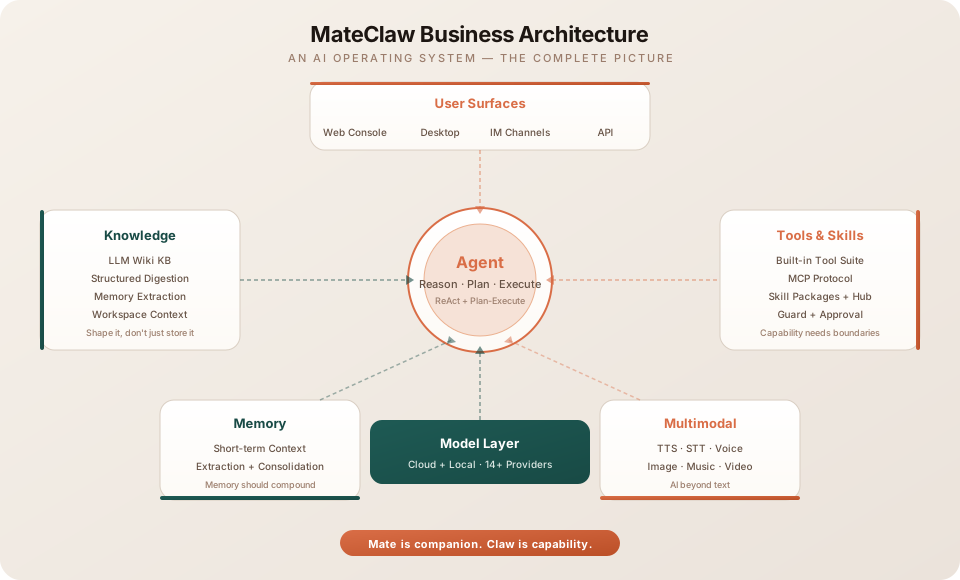
Technical architecture
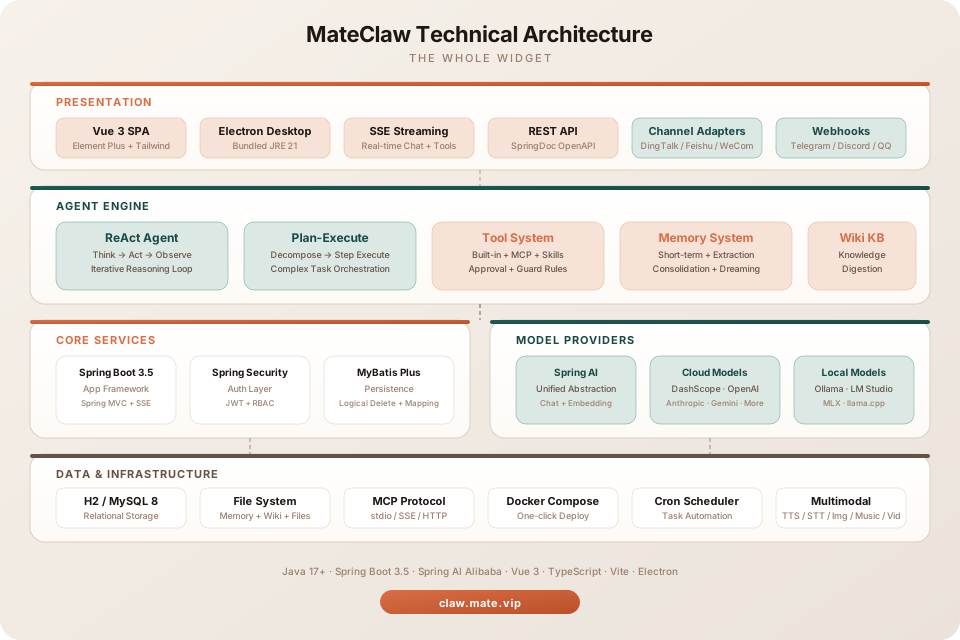
Project structure
mateclaw/
├── mateclaw-server/        Spring Boot 3.5 backend (Spring AI Alibaba, StateGraph runtime)
├── mateclaw-ui/            Vue 3 + TypeScript admin SPA (built into the server JAR)
├── mateclaw-webchat/       Embeddable chat widget (UMD / ES bundles)
├── mateclaw-plugin-api/    Java SDK for third-party capability plugins
├── mateclaw-plugin-sample/ Reference plugin implementation
├── docker-compose.yml
└── .env.example
Desktop binaries ship via GitHub Releases with a bundled JRE 21 — no Java install needed.
Tech stack
| Layer | Technology |
|---|---|
| Backend | Spring Boot 3.5 · Spring AI Alibaba 1.1 · MyBatis Plus · Flyway |
| Agent | StateGraph runtime · ReAct + Plan-Execute |
| Database | H2 (dev) · MySQL 8.0+ (prod) |
| Auth | Spring Security + JWT |
| Frontend | Vue 3 · TypeScript · Vite · Element Plus · TailwindCSS 4 |
| Desktop | Electron · electron-updater · JRE 21 (bundled) |
| Widget | Vite library mode · UMD + ES bundles |
Documentation
Full docs at claw.mate.vip/docs — setup, architecture, each subsystem, API reference.
Roadmap
Sharper multi-agent collaboration · Smarter model routing · Deeper multimodal understanding · Longer-lived memory · A richer ClawHub.
Contributing
git clone https://github.com/matevip/mateclaw.git
cd mateclaw
cd mateclaw-server && mvn clean compile
cd ../mateclaw-ui && pnpm install && pnpm dev
Why the name
Mate is companion. Claw is capability.
Something that stays with you — and grabs work and moves it.
License
Apache License 2.0. No asterisks.