 2e0a4674e5
Inbound (WeCom):
- Save uploaded media under data/chat-uploads/{conversationId}/ with full
  fileName/path/fileUrl/storedName/fileSize on the content part. Web mirrors
  of an IM conversation now show real thumbnails instead of "未命名".
- Magic-byte sniff (PDF / PNG / JPEG / GIF / Office / ODF / archives /
  audio / video) recovers a real extension when the platform omits filename
  for forwarded files — no more PDFs labelled "file.bin".
- ZIP container peek distinguishes DOCX / XLSX / PPTX / VSDX / ODT / ODS /
  ODP / EPUB / JAR from a plain zip via discriminator paths and the OASIS
  mimetype entry.

Outbound (WeCom):
- Chunk upload field name corrected so server-side actually stores the
  bytes — file messages used to arrive with correct filename/size but
  empty content, breaking every PDF / DOCX / PPTX recipient.
- Scan agent text for served-file URLs in both the text-reply and
  content-parts paths; fetch bytes from the in-memory generated-file
  cache and dispatch through the native chunk upload + media message
  protocol so users receive a tappable file card instead of an
  unopenable markdown link. Cache miss surfaces a clear retry hint.

Async tool result forwarding:
- New AsyncTaskMediaDispatcher routes generation completions (image,
  video, music, 3D model) to whichever IM channel the conversation is
  bound to via ChannelSessionStore + ChannelManager. Web / webchat
  conversations are intentionally skipped — their SSE stream already
  renders the result.
- Wired into all four generation services so IM users actually receive
  generated media as native attachments. Each part now carries an
  absolute disk path so adapters read bytes locally instead of round-
  tripping through an authenticated served URL.

Slack native file upload:
- SlackChannelAdapter overrides the content-parts dispatch. Image /
  audio / video / file / model3d parts ride filesUploadV2 so users see a
  file card with preview thumbnail bound to the same thread as the
  originating message. Text parts continue through chat.postMessage.
- Resolves bytes from the part's local path, falls back to an HTTP fetch
  of fully-qualified URLs.

IM approval hint visibility:
- IM-driven approve / deny / auto-cancel / replay-error hints now go
  through saveMessage + tracker broadcast in addition to the channel
  adapter, so a Web mirror viewing the same conversationId sees the
  resolution. Previously hints reached only the IM channel; the Web
  admin console had no record of the outcome.

Adaptive paste-merge debounce:
- WeCom and other IM clients silently split long pasted prompts into
  fragments that arrive 0.5-2 seconds apart, missing the existing 500ms
  merge window. The agent then saw torn context and emitted multiple
  conflicting replies.
- When the merged buffer crosses a content-length threshold, extend the
  debounce window so subsequent fragments arrive in time. Default
  500ms unchanged for normal short messages.
|
||
|---|---|---|
| .github/ISSUE_TEMPLATE | ||
| assets | ||
| docker/searxng | ||
| mateclaw-plugin-api | ||
| mateclaw-plugin-sample | ||
| mateclaw-server | ||
| mateclaw-ui | ||
| mateclaw-webchat | ||
| .dockerignore | ||
| .env.example | ||
| .gitignore | ||
| ai_assistant_proposal.md | ||
| docker-compose.yml | ||
| enterprise_ai_assistant_proposal.md | ||
| LICENSE | ||
| README_zh.md | ||
| README.md | ||










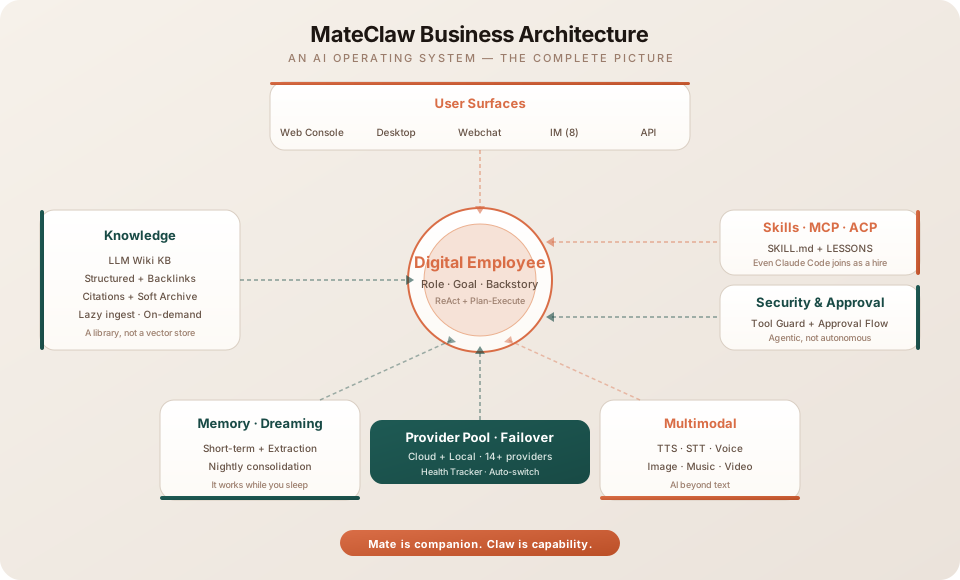
Other personal AI agents are built for one person. MateClaw is the one your IT department can actually sign off on.
Multi-user workspaces. Approval-gated sensitive actions. Full audit trail. Spring Boot Actuator health monitoring. Per-channel error isolation so one chat platform's outage doesn't take down the rest. One JAR on your own machine, zero data egress.
Most AI tools die when their vendor has a bad day. Most forget you the moment the tab closes. Most give you a chatbox and call it a product.
MateClaw is the whole widget. One deployment. Reasoning, knowledge, memory, tools, channels — built together, not bolted on. And when your primary model goes down, the next one picks up mid-sentence.
Three things that make it different
1 · Your AI doesn't die when a model does
Primary key expired. Vendor returns 401. Network blip. Quota drained.
Other tools hand you a red error card. MateClaw routes to the next healthy provider — DashScope, OpenAI, Anthropic, Gemini, DeepSeek, Kimi, Ollama, LM Studio, MLX, 14+ in total — and the user sees the reply finish. A provider health tracker parks bad vendors in a cooldown window so they don't waste seconds on every turn.
You don't write a retry script. You drag providers into priority order in Settings → Models and watch the health dashboard fill with green dots as requests route around failures in real time.
2 · Knowledge that links itself
Upload a PDF, a batch of markdown, a scraped page — raw material in.
MateClaw's LLM Wiki digests it into structured pages, builds [[links]] between them, and remembers where every sentence came from. Click a citation, see the exact source chunk. Ask a question, the page you get is stitched from the right chunks — with references you can verify.
This is the difference between a warehouse and a library.
3 · One product, five surfaces
| Surface | What it is |
|---|---|
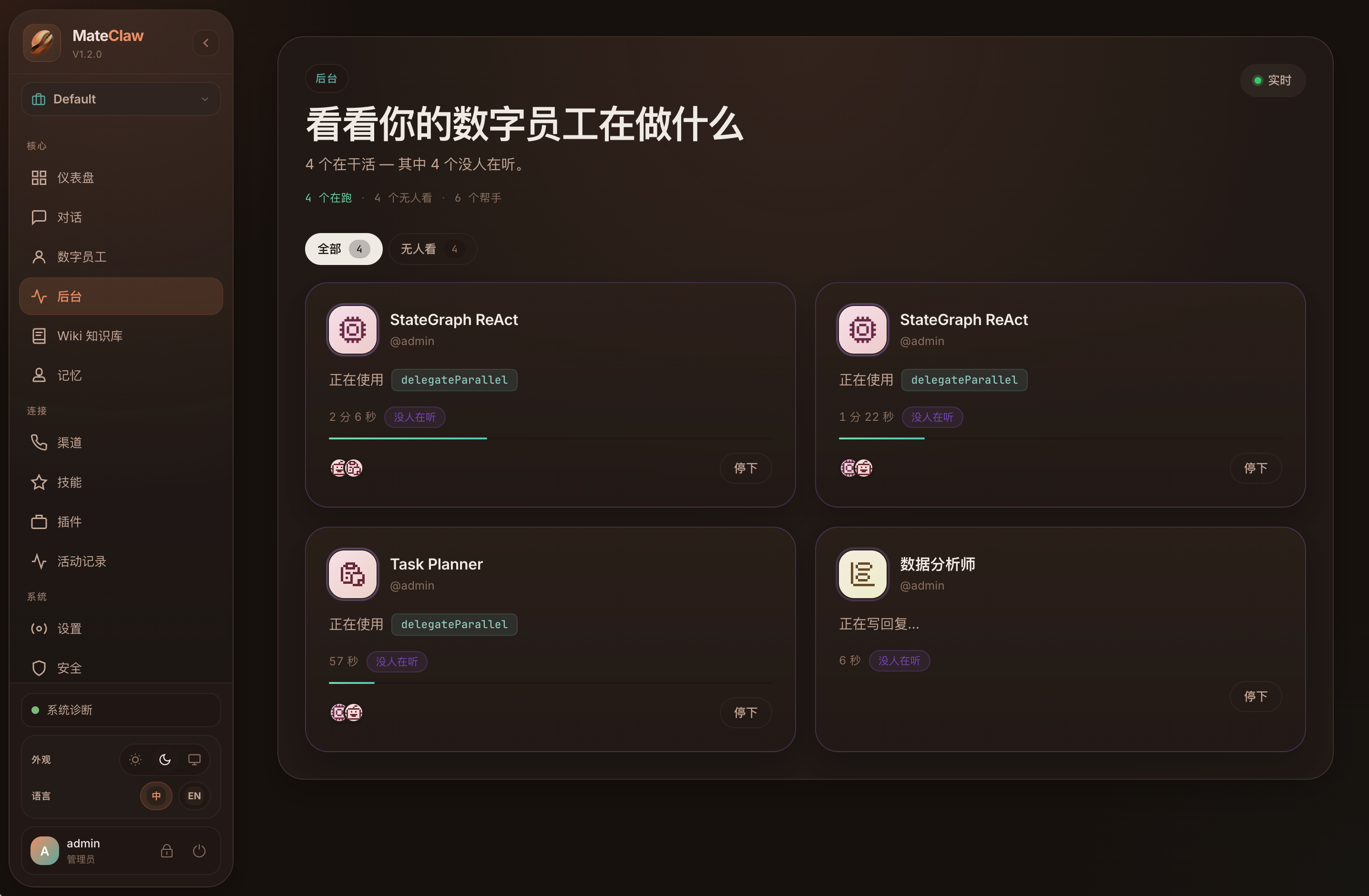
| Web Console | Full admin — digital employees, models, skills, knowledge, security, cron, runtime console (see what every employee is doing, force-recycle in one click) |
| Desktop | Electron app with a bundled JRE 21. Double-click, run. No Java install |
| Webchat Widget | One <script> tag embed. Drop it on any site |
| IM Channels | DingTalk · Feishu · WeChat Work · WeChat · Telegram · Discord · QQ · Slack |
| Plugin SDK | Java module for third-party capability packs |
Same brain. Same memory. Same tools. Different doors.
$0 · No tokens metered. No seats billed. Your server. Your data. Your keys.
What's in the box
Digital employees, not chatbots
You hire coworkers, not chat boxes. Each one has a Role, a Goal, a Backstory, a pixel-art avatar, and a color of their own — five career templates ship ready (Product Researcher · Customer Support · Knowledge Curator · Data Analyst · Executive Assistant). ReAct drives iterative reasoning, Plan-and-Execute decomposes complex multi-step work, employees can delegate to one another in parallel. Dynamic context pruning, smart truncation, stale-stream cleanup — the boring stuff that makes long conversations actually work.
Knowledge & memory
- LLM Wiki — raw materials digest into linked pages with citations; the hot cache auto-injects into every employee's system prompt
- Workspace memory —
AGENTS.md,SOUL.md,PROFILE.md,MEMORY.md, daily notes - Memory lifecycle — post-conversation extraction, scheduled consolidation, Dreaming workflows
Skills · MCP · ACP — three ways to extend capability
- SKILL.md packages — manifest + prompt + tool list + LESSONS.md (gets smarter the more you use it). Eight starter templates plus a five-step creation wizard, with Pre-flight checks that tell you what's missing before install
- MCP — stdio / SSE / Streamable HTTP, plug into any external tool server
- ACP — bring top-tier coding agents like Claude Code and Codex in as employees, auto-bridged to skill cards with wrapper tools
- Tool Guard — RBAC + approval flow + path protection. Capability needs boundaries
You see what every employee is doing
Admin Runtime Console (Settings → System → Runtime) — who's running, what step they're on, how many tokens, one-click force-recycle when stuck. Streaming is staged honestly (thinking / tool / answer), per-event SSE IDs make reconnects safe, multi-employee delegation no longer fights itself, long tasks demand evidence-grounded answers.
Multimodal creation
Text-to-speech · Speech-to-text · Image · Music · Video · 3D. First-class, not add-ons.
Enterprise-ready
RBAC + JWT. Personal Access Tokens for headless scripts and CI. HMAC-SHA-256 outbound webhook signing. Distributed Cron lock so multi-instance deployments don't double-fire. Full audit trail. Flyway-managed schema that auto-heals on upgrade. One JAR to ship. MySQL in production, H2 for dev — nothing to change in your code.
AI is becoming infrastructure
On March 2, 2026, Claude went dark for 4 hours across API, web, and mobile. Three weeks later, another 5 hours. Every company that bet their AI strategy on a single vendor spent those outages staring at red error cards.
This is the same shift databases went through around 2010 and cloud went through around 2018: the winning layer stops being tied to one supplier. 57% of companies now run AI agents in production. None of them want one vendor's bad day to become their bad day.
MateClaw is that layer — built the Spring Boot way.
Why MateClaw
| MateClaw | OpenClaw | Hermes Agent | Claude Code | Cursor | |
|---|---|---|---|---|---|
| Multi-vendor failover | Chain + health tracker + cooldown | Swap providers via config | Orchestration w/ retry | Anthropic only | One model |
| Knowledge digestion | LLM Wiki + page-level citations | Canvas + memory | Skills Hub + memory | — | Code index |
| Multi-user admin | RBAC + approval + audit + runtime console | Config-file first | Single-user CLI | Enterprise tier | Teams plan |
| Capability extension | Skills (LESSONS) + MCP + ACP | — | — | MCP | MCP |
| Surfaces | Web admin + Desktop + Widget + SDK + 8 IM | 25+ chat channels | 15+ channels (CLI-led) | 3 IM preview | IDE only |
| Stack | Java (Spring Boot) | TypeScript | Python | TypeScript | Electron/TS |
| License / Price | Apache 2.0 · Free | MIT · Free | MIT · Free | Proprietary · $20–200/mo | Proprietary · $0–200/mo |
OpenClaw and Hermes Agent are excellent personal AI platforms — pick either if you're running one user on one laptop, building your own agent from CLI, and treating everything as config files to hand-tune. Both have bigger communities than MateClaw today.
MateClaw is the version built for teams. RBAC per digital employee, per model, per tool. An approval flow that pauses risky actions for review. Full audit trail. The Admin Runtime Console gives one operator real-time visibility into 50 employees running across 14 vendors — stuck? force-recycle in one click. Spring Boot inside — drop-in for any Java shop already running production services.
Same "whole widget" philosophy. Different center of gravity.
Quick start
# Backend
cd mateclaw-server
mvn spring-boot:run           # http://localhost:18088

# Frontend
cd mateclaw-ui
pnpm install && pnpm dev      # http://localhost:5173
Login: admin / admin123
Docker
cp .env.example .env
docker compose up -d          # http://localhost:18080
Desktop
Download from GitHub Releases. Bundles JRE 21. No Java install needed.
Architecture
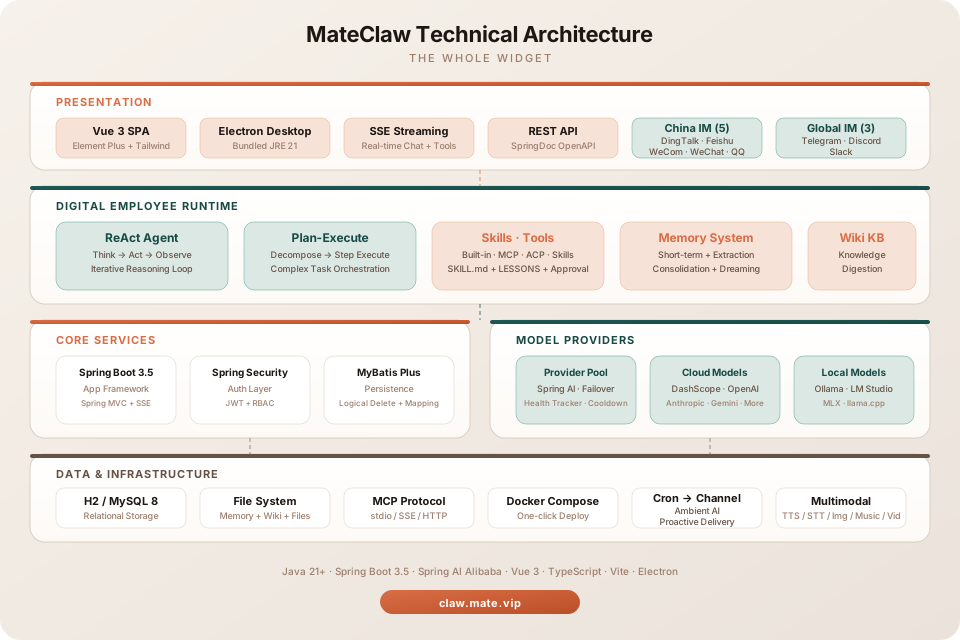
Technical architecture
Project structure
mateclaw/
├── mateclaw-server/        Spring Boot 3.5 backend (Spring AI Alibaba, StateGraph runtime)
├── mateclaw-ui/            Vue 3 + TypeScript admin SPA (built into the server JAR)
├── mateclaw-webchat/       Embeddable chat widget (UMD / ES bundles)
├── mateclaw-plugin-api/    Java SDK for third-party capability plugins
├── mateclaw-plugin-sample/ Reference plugin implementation
├── docker-compose.yml
└── .env.example
Desktop binaries ship via GitHub Releases with a bundled JRE 21 — no Java install needed.
Tech stack
| Layer | Technology |
|---|---|
| Backend | Spring Boot 3.5 · Spring AI Alibaba 1.1 · MyBatis Plus · Flyway |
| Digital Employee Runtime | StateGraph · ReAct + Plan-Execute · Role / Goal / Backstory · LESSONS self-evolution |
| Capability Extension | SKILL.md packages · MCP (stdio / SSE / HTTP) · ACP bridge (Claude Code / Codex) |
| Database | H2 (dev) · MySQL 8.0+ (prod) |
| Auth | Spring Security + JWT |
| Frontend | Vue 3 · TypeScript · Vite · Element Plus · TailwindCSS 4 |
| Desktop | Electron · electron-updater · JRE 21 (bundled) |
| Widget | Vite library mode · UMD + ES bundles |
Documentation
Full docs at claw.mate.vip/docs — setup, architecture, each subsystem, API reference.
Roadmap
Sharper multi-employee collaboration · Smarter model routing · Deeper multimodal understanding · Longer-lived memory · A richer ClawHub · More ACP upstream integrations.
Contributing
git clone https://github.com/matevip/mateclaw.git
cd mateclaw
cd mateclaw-server && mvn clean compile
cd ../mateclaw-ui && pnpm install && pnpm dev
Why the name
Mate is companion. Claw is capability.
Something that stays with you — and grabs work and moves it.
License
Apache License 2.0. No asterisks.