 b4697f2806
User-reported field issues + a deeper code audit revealed multiple overlapping bugs in the prior cron-channel delivery change. This fixes all six. #1 — Concurrency race on ToolExecutionExecutor (root cause of 'sometimes succeeds, sometimes fails' tool calls). The volatile instance fields currentRequesterId / currentWorkspaceBasePath / currentChatOrigin were shared by every conversation routed through the same per-agent executor; one user mid-build-loop while another's execute() overwrote the field would cross-contaminate the captured values into PreparedToolCall. Fix: kill the instance fields, thread origin/requester/workspace as method params straight into PreparedToolCall snapshot. Comment pins the rule so it cannot regress. #2 — CHAT_ORIGIN missing from KeyStrategyFactory (latent timebomb, masked by spring-ai-alibaba-graph-core's non-filtering builder path). Without an addStrategy registration, multi-node state merges in long ReAct / Plan-Execute loops drop the key, ActionNode reads ChatOrigin.EMPTY, and the cron persists with channel_id=NULL. Also caught 4 more keys that were latently unregistered: WORKSPACE_BASE_PATH, STOP_REQUESTED, RETURN_DIRECT_TRIGGERED, DIRECT_TOOL_OUTPUTS. All five now registered in both ReAct and Plan-Execute factories. #3 — CronJobs UI didn't surface channel binding. CronJobDTO carried channelId / deliveryConfig but the list page never rendered them. Added: (a) 'channel' column on list page, (b) channel + targetId rows in the detail modal, (c) backend batch-loads channel names via ChannelMapper.selectBatchIds so the column shows the human-readable name, (d) i18n keys (zh + en), (e) channelName field on TS CronJob type. #4a — DingTalk targetId expiry. ChannelChatOriginFactory.resolveTargetId used to prefer ChannelMessage.replyToken which for DingTalk encodes a sessionWebhook URL that expires ~90 minutes after the inbound message. Cron persisted with that webhook then dies with 401/403 and marks NOT_DELIVERED forever. Fix: prefer the stable chatId, fall back to senderId — both work indefinitely via DingTalk's Robot API. #4b — Scheduler pool exhaustion under long LLM. CronJobService's ThreadPoolTaskScheduler ran with poolSize=4 AND the LLM call lived on the scheduler thread. Four concurrent crons saturated the pool and the 5th silently missed its tick. Fix: keep scheduler tiny (it just fires triggers) and offload runAgent to a dedicated virtual-thread executor (cron-execute-* threads). LLM workload is I/O-bound — virtual threads scale to thousands at trivial cost. #5 — Minor latent bugs: - AbstractCronResultDelivery.claimRun used .in(... 'NONE','PENDING',null), but SQL IN never matches NULL. Rewrote as IS NULL OR IN (NONE,PENDING) so legacy pre-V57 rows can still claim. - CronDeliveryListener.onCompletedRaw was an empty @EventListener with a wrong-headed comment about test fallbackExecution. Removed. - CronJobTool.resolveAgentId silently returned 1L when origin lacked an agentId — would silently bind to whatever agent #1 happens to be. Replaced with explicit error so wiring bugs surface immediately instead of producing scheduled-but-never-runs crons. State-key registration guard. New StateKeyRegistrationCoverageTest scans MateClawStateKeys via reflection and parses AgentGraphBuilder.java to extract every .addStrategy(MateClawStateKeys.X, ...). Asserts every non-_NODE constant appears in at least one factory. Caught the 4 unregistered keys above on first run; will catch any future 'forgot to register' regression. Tests: 33 unit/arch tests + 27 regression in touched areas — all green. Vue typecheck clean. Refs: #25, #16 |
||
|---|---|---|
| assets | ||
| docker/searxng | ||
| mateclaw-plugin-api | ||
| mateclaw-plugin-sample | ||
| mateclaw-server | ||
| mateclaw-ui | ||
| mateclaw-webchat | ||
| .dockerignore | ||
| .env.example | ||
| .gitignore | ||
| docker-compose.yml | ||
| LICENSE | ||
| README_zh.md | ||
| README.md | ||










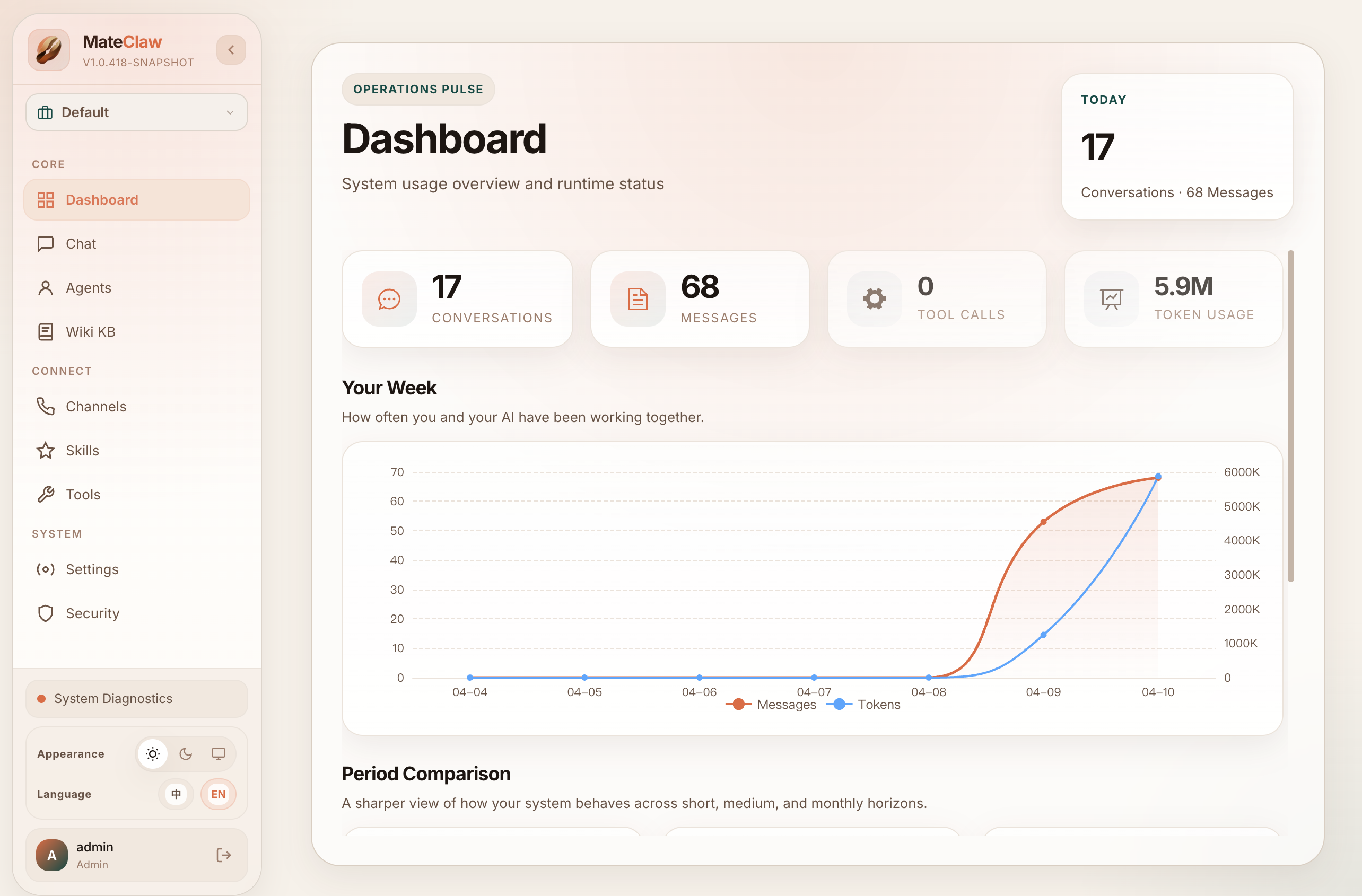
Most AI tools die when their vendor has a bad day. Most forget you the moment the tab closes. Most give you a chatbox and call it a product.
MateClaw is the whole widget. One deployment. Reasoning, knowledge, memory, tools, channels — built together, not bolted on. And when your primary model goes down, the next one picks up mid-sentence.
Three things that make it different
1 · Your AI doesn't die when a model does
Primary key expired. Vendor returns 401. Network blip. Quota drained.
Other tools hand you a red error card. MateClaw routes to the next healthy provider — DashScope, OpenAI, Anthropic, Gemini, DeepSeek, Kimi, Ollama, LM Studio, MLX, 14+ in total — and the user sees the reply finish. A provider health tracker parks bad vendors in a cooldown window so they don't waste seconds on every turn.
You don't write a retry script. You drag providers into priority order in Settings → Models and watch the health dashboard fill with green dots as requests route around failures in real time.
2 · Knowledge that links itself
Upload a PDF, a batch of markdown, a scraped page — raw material in.
MateClaw's LLM Wiki digests it into structured pages, builds [[links]] between them, and remembers where every sentence came from. Click a citation, see the exact source chunk. Ask a question, the page you get is stitched from the right chunks — with references you can verify.
This is the difference between a warehouse and a library.
3 · One product, five surfaces
| Surface | What it is |
|---|---|
| Web Console | Full admin — agents, models, tools, skills, knowledge, security, cron |
| Desktop | Electron app with a bundled JRE 21. Double-click, run. No Java install |
| Webchat Widget | One <script> tag embed. Drop it on any site |
| IM Channels | DingTalk · Feishu · WeChat Work · Telegram · Discord · QQ |
| Plugin SDK | Java module for third-party capability packs |
Same brain. Same memory. Same tools. Different doors.
$0 · No tokens metered. No seats billed. Your server. Your data. Your keys.
What's in the box
Agent runtime
ReAct for iterative reasoning. Plan-and-Execute for complex multi-step work. Dynamic context pruning, smart truncation, stale-stream cleanup — the boring stuff that makes long conversations actually work.
Knowledge & memory
- LLM Wiki — raw materials digest into linked pages with citations
- Workspace memory —
AGENTS.md,SOUL.md,PROFILE.md,MEMORY.md, daily notes - Memory lifecycle — post-conversation extraction, scheduled consolidation, dreaming workflows
Tools, skills, MCP
Built-in tools for web search, files, memory, date/time. MCP over stdio / SSE / Streamable HTTP. SKILL.md packages from the ClawHub marketplace. A Tool Guard layer with RBAC, approval flows, and path protection — capability needs boundaries.
Multimodal creation
Text-to-speech · Speech-to-text · Image · Music · Video. First-class, not add-ons.
Enterprise-ready
RBAC + JWT. Full audit trail. Flyway-managed schema that auto-heals on upgrade. One JAR to ship. MySQL in production, H2 for dev — nothing to change in your code.
AI is becoming infrastructure
On March 2, 2026, Claude went dark for 4 hours across API, web, and mobile. Three weeks later, another 5 hours. Every company that bet their AI strategy on a single vendor spent those outages staring at red error cards.
This is the same shift databases went through around 2010 and cloud went through around 2018: the winning layer stops being tied to one supplier. 57% of companies now run AI agents in production. None of them want one vendor's bad day to become their bad day.
MateClaw is that layer — built the Spring Boot way.
Why MateClaw
| MateClaw | OpenClaw | Hermes Agent | Claude Code | Cursor | |
|---|---|---|---|---|---|
| Multi-vendor failover | Chain + health tracker + cooldown | Swap providers via config | Orchestration w/ retry | Anthropic only | One model |
| Knowledge digestion | LLM Wiki + page-level citations | Canvas + memory | Skills Hub + memory | — | Code index |
| Multi-user admin | RBAC + approval flow + audit | Config-file first | Single-user CLI | Enterprise tier | Teams plan |
| Surfaces | Web admin + Desktop + Widget + SDK + 6 IM | 25+ chat channels | 15+ channels (CLI-led) | 3 IM preview | IDE only |
| Stack | Java (Spring Boot) | TypeScript | Python | TypeScript | Electron/TS |
| License / Price | Apache 2.0 · Free | MIT · Free | MIT · Free | Proprietary · $20–200/mo | Proprietary · $0–200/mo |
OpenClaw and Hermes Agent are excellent personal AI platforms — pick either if you're running one user on one laptop, building your own agent from CLI, and treating everything as config files to hand-tune. Both have bigger communities than MateClaw today.
MateClaw is the version built for teams. RBAC per agent, per model, per tool. An approval flow that pauses risky actions for review. Full audit trail. A web admin dashboard where one operator manages 50 agents across 14 vendors. Spring Boot inside — drop-in for any Java shop already running production services.
Same "whole widget" philosophy. Different center of gravity.
Quick start
# Backend
cd mateclaw-server
mvn spring-boot:run           # http://localhost:18088

# Frontend
cd mateclaw-ui
pnpm install && pnpm dev      # http://localhost:5173
Login: admin / admin123
Docker
cp .env.example .env
docker compose up -d          # http://localhost:18080
Desktop
Download from GitHub Releases. Bundles JRE 21. No Java install needed.
Architecture
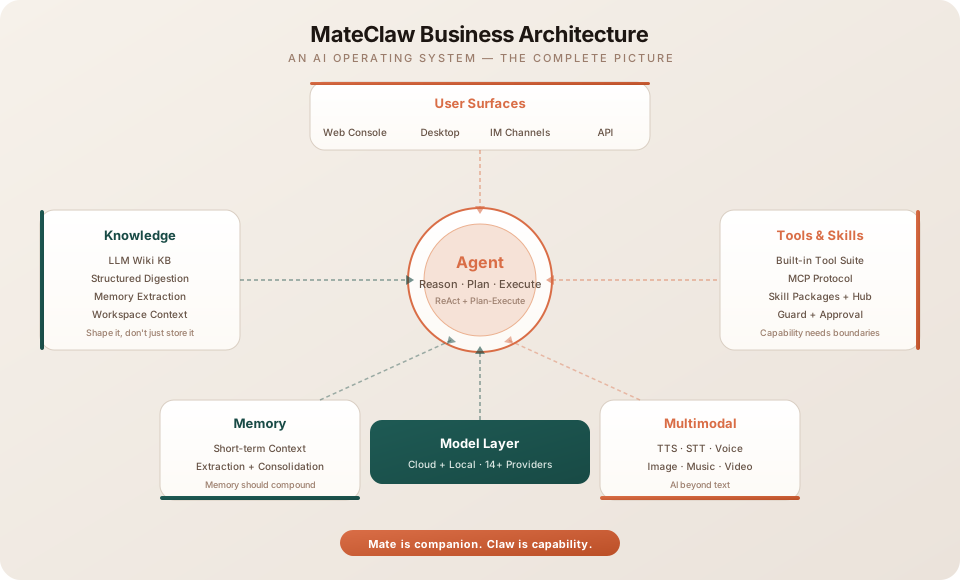
Technical architecture
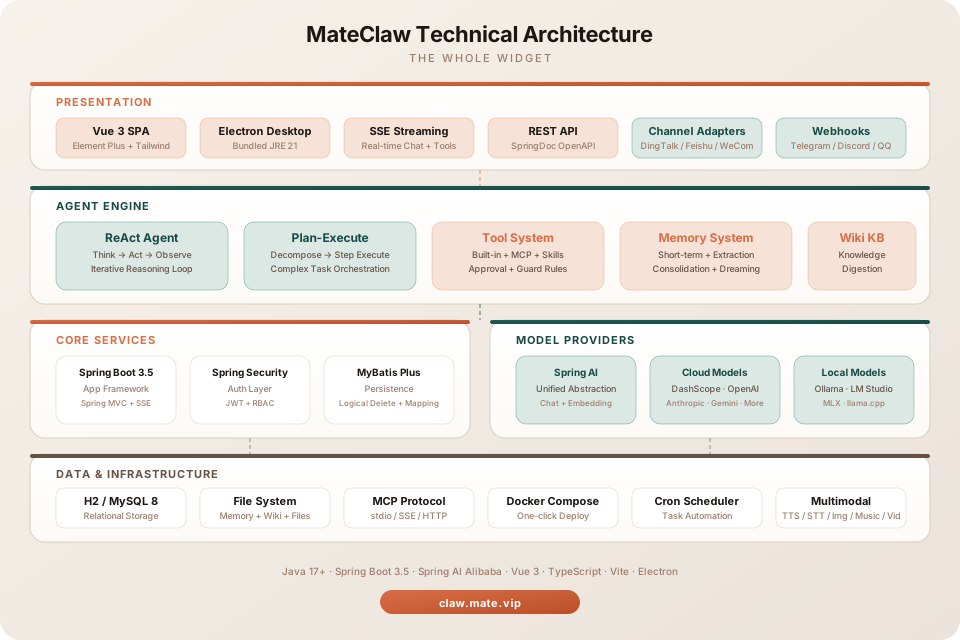
Project structure
mateclaw/
├── mateclaw-server/        Spring Boot 3.5 backend (Spring AI Alibaba, StateGraph runtime)
├── mateclaw-ui/            Vue 3 + TypeScript admin SPA (built into the server JAR)
├── mateclaw-webchat/       Embeddable chat widget (UMD / ES bundles)
├── mateclaw-plugin-api/    Java SDK for third-party capability plugins
├── mateclaw-plugin-sample/ Reference plugin implementation
├── docker-compose.yml
└── .env.example
Desktop binaries ship via GitHub Releases with a bundled JRE 21 — no Java install needed.
Tech stack
| Layer | Technology |
|---|---|
| Backend | Spring Boot 3.5 · Spring AI Alibaba 1.1 · MyBatis Plus · Flyway |
| Agent | StateGraph runtime · ReAct + Plan-Execute |
| Database | H2 (dev) · MySQL 8.0+ (prod) |
| Auth | Spring Security + JWT |
| Frontend | Vue 3 · TypeScript · Vite · Element Plus · TailwindCSS 4 |
| Desktop | Electron · electron-updater · JRE 21 (bundled) |
| Widget | Vite library mode · UMD + ES bundles |
Documentation
Full docs at claw.mate.vip/docs — setup, architecture, each subsystem, API reference.
Roadmap
Sharper multi-agent collaboration · Smarter model routing · Deeper multimodal understanding · Longer-lived memory · A richer ClawHub.
Contributing
git clone https://github.com/matevip/mateclaw.git
cd mateclaw
cd mateclaw-server && mvn clean compile
cd ../mateclaw-ui && pnpm install && pnpm dev
Why the name
Mate is companion. Claw is capability.
Something that stays with you — and grabs work and moves it.
License
Apache License 2.0. No asterisks.