 c0c642380a
Phase 1 of the model-module refactor: combine pool / cooldown / probe-
completion signals into a single Liveness state surfaced through the
provider DTO, so the dropdown stops listing providers that are provably
unreachable. Zero schema change; one PR backend + frontend.

Backend
- Liveness enum with five mutually-exclusive states: LIVE, COOLDOWN,
  REMOVED, UNPROBED, UNCONFIGURED. Computed in ModelProviderService
  from AvailableProviderPool / ProviderHealthTracker / ProviderInitProbe
  snapshots batched once per listProviders() call.
- ProviderInitProbe.hasBeenProbed exposes a monotonic Set so the UI
  can distinguish 'still booting' from 'probed and removed' — without
  it the startup window flashes false REMOVED states.
- ProviderInfoDTO gains liveness + unavailableReason +
  cooldownRemainingMs + lastProbedAtMs. The legacy 'available' boolean
  stays but is now derived from liveness == LIVE so the chat fallback
  walker and the dropdown agree about what's usable.
- ProviderInitProbe injected into ModelProviderService via
  ObjectProvider to break the startup cycle (probe already depends on
  the service).

Frontend
- ProviderInfo type extended with liveness + the three detail fields.
- ModelSelector filters UNCONFIGURED + REMOVED out of the dropdown,
  shows COOLDOWN / UNPROBED with a status dot and dimmed rows that the
  user can still click to override.
- ProviderCard renders a five-state badge driven by liveness instead
  of the old configured + pool-entry combo. Reprobe button now keys
  off liveness in {REMOVED, COOLDOWN}.
- useProviders drops loadProviderPool / providerPool — pool data ships
  inline on each ProviderInfo, saves a round trip per page load and
  keeps a single source of truth.
- i18n: 8 new keys across zh-CN and en-US for liveness labels and the
  cooldown countdown tooltips.

Bonus fix (discovered during verification): AgentGraphBuilder.buildOpenAiApi
hard-required a usable API key on every OpenAI-compat provider, ignoring
the per-provider requireApiKey flag. That bug stranded keyless local
runtimes (LM Studio / MLX / llama.cpp) the moment a user actually
launched them; Ollama only worked by accident because its seed row
carries a placeholder string in api_key. keyRequired now honors
requireApiKey, and Spring AI's NoopApiKey is used when no key is needed
so the Authorization header is omitted entirely.

Test
- ModelProviderServiceLivenessTest covers all five Liveness states +
  the probe-bean-absent fallback branch.
- vip.mate.llm.** suite (118 tests) green; vue-tsc clean.
- End-to-end browser sanity: 27 raw providers reduce to 6 LIVE groups
  in the chat dropdown; LM Studio / MLX / llama.cpp render REMOVED red
  badges with reprobe buttons; cloud providers without keys show
  UNCONFIGURED.
|
||
|---|---|---|
| assets | ||
| docker/searxng | ||
| mateclaw-plugin-api | ||
| mateclaw-plugin-sample | ||
| mateclaw-server | ||
| mateclaw-ui | ||
| mateclaw-webchat | ||
| .dockerignore | ||
| .env.example | ||
| .gitignore | ||
| docker-compose.yml | ||
| LICENSE | ||
| README_zh.md | ||
| README.md | ||










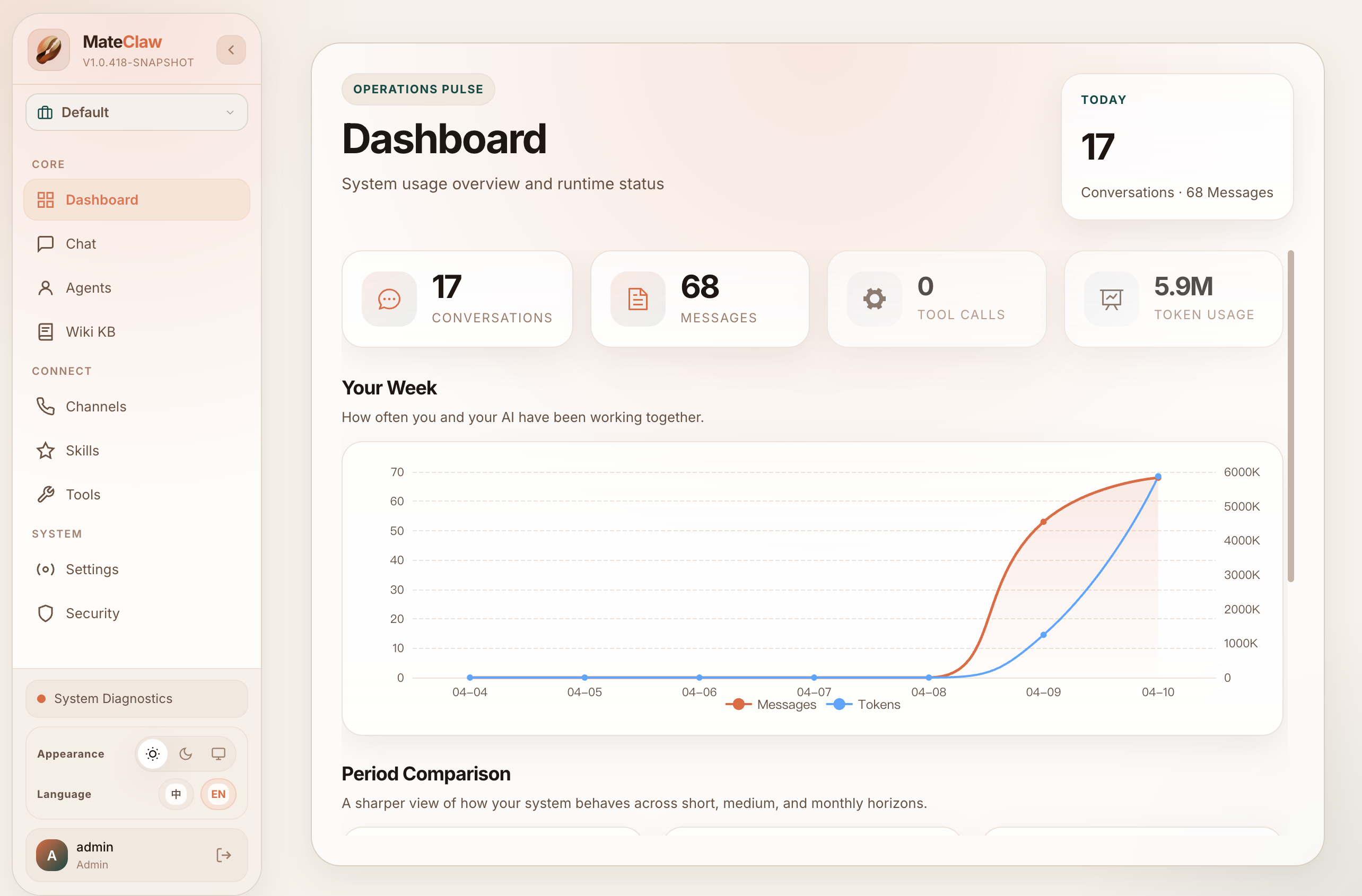
Most AI tools die when their vendor has a bad day. Most forget you the moment the tab closes. Most give you a chatbox and call it a product.
MateClaw is the whole widget. One deployment. Reasoning, knowledge, memory, tools, channels — built together, not bolted on. And when your primary model goes down, the next one picks up mid-sentence.
Three things that make it different
1 · Your AI doesn't die when a model does
Primary key expired. Vendor returns 401. Network blip. Quota drained.
Other tools hand you a red error card. MateClaw routes to the next healthy provider — DashScope, OpenAI, Anthropic, Gemini, DeepSeek, Kimi, Ollama, LM Studio, MLX, 14+ in total — and the user sees the reply finish. A provider health tracker parks bad vendors in a cooldown window so they don't waste seconds on every turn.
You don't write a retry script. You drag providers into priority order in Settings → Models and watch the health dashboard fill with green dots as requests route around failures in real time.
2 · Knowledge that links itself
Upload a PDF, a batch of markdown, a scraped page — raw material in.
MateClaw's LLM Wiki digests it into structured pages, builds [[links]] between them, and remembers where every sentence came from. Click a citation, see the exact source chunk. Ask a question, the page you get is stitched from the right chunks — with references you can verify.
This is the difference between a warehouse and a library.
3 · One product, five surfaces
| Surface | What it is |
|---|---|
| Web Console | Full admin — agents, models, tools, skills, knowledge, security, cron |
| Desktop | Electron app with a bundled JRE 21. Double-click, run. No Java install |
| Webchat Widget | One <script> tag embed. Drop it on any site |
| IM Channels | DingTalk · Feishu · WeChat Work · Telegram · Discord · QQ |
| Plugin SDK | Java module for third-party capability packs |
Same brain. Same memory. Same tools. Different doors.
$0 · No tokens metered. No seats billed. Your server. Your data. Your keys.
What's in the box
Agent runtime
ReAct for iterative reasoning. Plan-and-Execute for complex multi-step work. Dynamic context pruning, smart truncation, stale-stream cleanup — the boring stuff that makes long conversations actually work.
Knowledge & memory
- LLM Wiki — raw materials digest into linked pages with citations
- Workspace memory —
AGENTS.md,SOUL.md,PROFILE.md,MEMORY.md, daily notes - Memory lifecycle — post-conversation extraction, scheduled consolidation, dreaming workflows
Tools, skills, MCP
Built-in tools for web search, files, memory, date/time. MCP over stdio / SSE / Streamable HTTP. SKILL.md packages from the ClawHub marketplace. A Tool Guard layer with RBAC, approval flows, and path protection — capability needs boundaries.
Multimodal creation
Text-to-speech · Speech-to-text · Image · Music · Video. First-class, not add-ons.
Enterprise-ready
RBAC + JWT. Full audit trail. Flyway-managed schema that auto-heals on upgrade. One JAR to ship. MySQL in production, H2 for dev — nothing to change in your code.
AI is becoming infrastructure
On March 2, 2026, Claude went dark for 4 hours across API, web, and mobile. Three weeks later, another 5 hours. Every company that bet their AI strategy on a single vendor spent those outages staring at red error cards.
This is the same shift databases went through around 2010 and cloud went through around 2018: the winning layer stops being tied to one supplier. 57% of companies now run AI agents in production. None of them want one vendor's bad day to become their bad day.
MateClaw is that layer — built the Spring Boot way.
Why MateClaw
| MateClaw | OpenClaw | Hermes Agent | Claude Code | Cursor | |
|---|---|---|---|---|---|
| Multi-vendor failover | Chain + health tracker + cooldown | Swap providers via config | Orchestration w/ retry | Anthropic only | One model |
| Knowledge digestion | LLM Wiki + page-level citations | Canvas + memory | Skills Hub + memory | — | Code index |
| Multi-user admin | RBAC + approval flow + audit | Config-file first | Single-user CLI | Enterprise tier | Teams plan |
| Surfaces | Web admin + Desktop + Widget + SDK + 6 IM | 25+ chat channels | 15+ channels (CLI-led) | 3 IM preview | IDE only |
| Stack | Java (Spring Boot) | TypeScript | Python | TypeScript | Electron/TS |
| License / Price | Apache 2.0 · Free | MIT · Free | MIT · Free | Proprietary · $20–200/mo | Proprietary · $0–200/mo |
OpenClaw and Hermes Agent are excellent personal AI platforms — pick either if you're running one user on one laptop, building your own agent from CLI, and treating everything as config files to hand-tune. Both have bigger communities than MateClaw today.
MateClaw is the version built for teams. RBAC per agent, per model, per tool. An approval flow that pauses risky actions for review. Full audit trail. A web admin dashboard where one operator manages 50 agents across 14 vendors. Spring Boot inside — drop-in for any Java shop already running production services.
Same "whole widget" philosophy. Different center of gravity.
Quick start
# Backend
cd mateclaw-server
mvn spring-boot:run           # http://localhost:18088

# Frontend
cd mateclaw-ui
pnpm install && pnpm dev      # http://localhost:5173
Login: admin / admin123
Docker
cp .env.example .env
docker compose up -d          # http://localhost:18080
Desktop
Download from GitHub Releases. Bundles JRE 21. No Java install needed.
Architecture
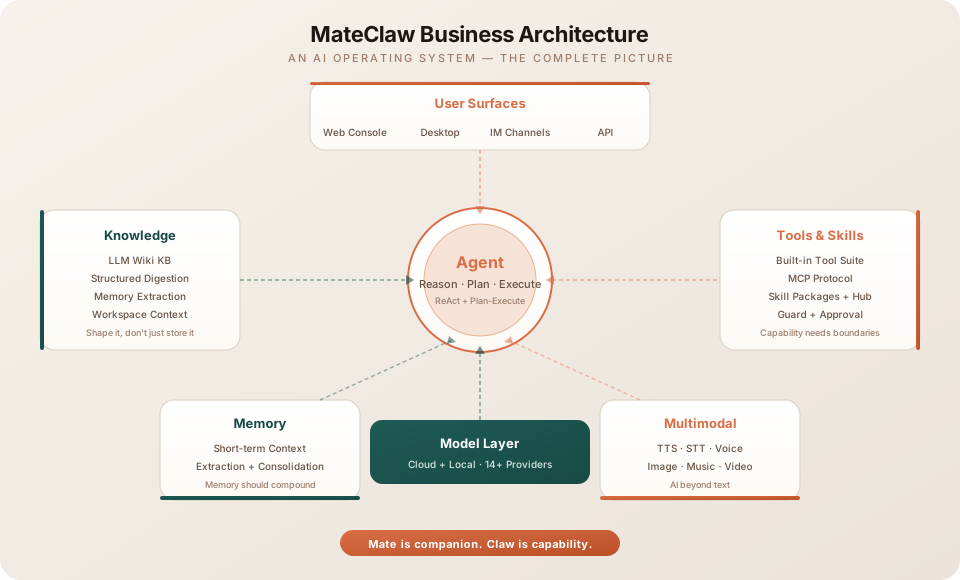
Technical architecture
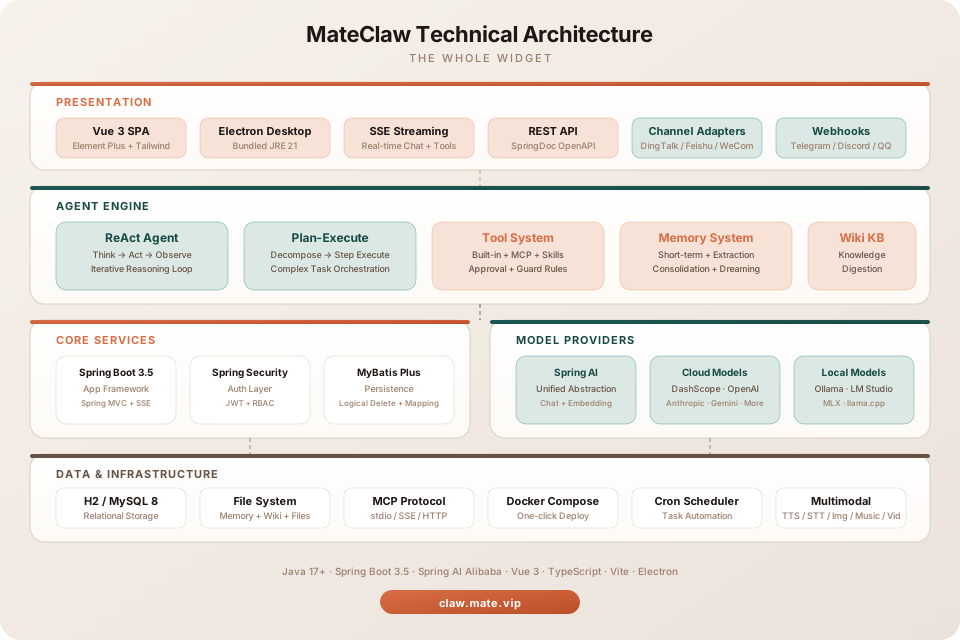
Project structure
mateclaw/
├── mateclaw-server/        Spring Boot 3.5 backend (Spring AI Alibaba, StateGraph runtime)
├── mateclaw-ui/            Vue 3 + TypeScript admin SPA (built into the server JAR)
├── mateclaw-webchat/       Embeddable chat widget (UMD / ES bundles)
├── mateclaw-plugin-api/    Java SDK for third-party capability plugins
├── mateclaw-plugin-sample/ Reference plugin implementation
├── docker-compose.yml
└── .env.example
Desktop binaries ship via GitHub Releases with a bundled JRE 21 — no Java install needed.
Tech stack
| Layer | Technology |
|---|---|
| Backend | Spring Boot 3.5 · Spring AI Alibaba 1.1 · MyBatis Plus · Flyway |
| Agent | StateGraph runtime · ReAct + Plan-Execute |
| Database | H2 (dev) · MySQL 8.0+ (prod) |
| Auth | Spring Security + JWT |
| Frontend | Vue 3 · TypeScript · Vite · Element Plus · TailwindCSS 4 |
| Desktop | Electron · electron-updater · JRE 21 (bundled) |
| Widget | Vite library mode · UMD + ES bundles |
Documentation
Full docs at claw.mate.vip/docs — setup, architecture, each subsystem, API reference.
Roadmap
Sharper multi-agent collaboration · Smarter model routing · Deeper multimodal understanding · Longer-lived memory · A richer ClawHub.
Contributing
git clone https://github.com/matevip/mateclaw.git
cd mateclaw
cd mateclaw-server && mvn clean compile
cd ../mateclaw-ui && pnpm install && pnpm dev
Why the name
Mate is companion. Claw is capability.
Something that stays with you — and grabs work and moves it.
License
Apache License 2.0. No asterisks.